Rabu, 29 Juli 2009

Utile et Dulce

The significance of the Horatian concept of “utile et dulce” to the development of literary criticism was the way people to rethink about literature. Horace believes that literature, especially poetry, should have great values, utile et dulce, useful and beautiful. It means both teaching and delighting the readers should also exist in poetry. Horace surely influenced by previous philosophers such as Socrates, Plato and Aristotle in his ideas. This concept in personally is attempting, since it makes people need to redefine the term of beautiful and useful. These terms may have different definitions for each person, so that we cannot generalise them. A beauty for a person may be plain for others, and in contrary. As well with usefulness, a person may call it useful but not to others. So that, in my opinion the standard of beauty and usefulness is not equal for each person. 

There are four major periods of Greek literature: preclassical, classical, Hellenistic-Roman, and Byzantine. Of these the most significant works were produced during the preclassical and classical eras. All of them are influencing the literary thought both on Renaissance and Augustan literature and criticism. All philosophy is footnoted to Plato, which is a similar point can be made regarding Greek literature as a whole. So that Renaissance age was marked by an intense interest in the visible world and in the knowledge derived from concrete sensory experience. It turned away from the abstract speculations and interest in life after death that characterized the middle ages. Although Christianity was not abandoned, the otherworldliness and monastic ideology of the middle ages were largely discarded. The focus during the Renaissance turned from abstract discussions of religious issues to the morality of human actions. Augustan Age was the period after the Restoration era to the death of Alexander Pope. The literature of this period conforming to Pope's aesthetic principles is distinguished by its striving for harmony and precision, its urbanity, and its imitation of classical models such as Homer, Cicero, Virgil, and Horace.

Rabu, 03 Juni 2009

Metaphor and Metonymy: The Linguistic Disorders

Roman Jakobson illustrates the complexity relationship between psychological linguistic and literary criticism. The description begins with a discussion about the relationship between metaphor and metonymy–the two polar types of aphasia, a brain disorder affecting speech. Aphasic disturbance consist some impairment, either for selection and substitution or for combination and contexture. The relation of similarity is suppressed previously, while the contiguity is the latest type of aphasia. Jakobson presumes that metaphor is an alien to the similarity disorder and metonymy to the contiguity disorder. But the discourse happens in the semantic phase where one topic may lead to another either through their similarity or contiguity. Yet, in normal verbal behaviour, metaphor and metonymy reveal under the influence of the cultural pattern and personality, the verbal style preference is given to one of the two processes over the other. Manipulating the similarity and contiguity in positional and semantic aspects is exhibiting someone’s personal style, his verbal predilections and preferences.

In poetry there are various motives determining the choice between metaphor and metonymy. A competition between them is manifested in any symbolic process, either intrapersonal or social. J. G. Frazer principle divides them into two types: charms based on the law of similarity and those based by contiguity. The first of the two great branches of sympathetic magic has been called homeopathic or imitative, and the second is contagious magic. Romantic is closely linked metaphor, whereas reality to metonymy. The similarity in meaning connects the symbols of a metalanguage with the symbols of the language referred to. Similarity connects a metaphorical term with the substituted one.

Poetry is focused upon sign, and pragmatically prose primarily upon referent, tropes, and figures were studied mainly as poetical devices. The principle of similarity underlies poetry; the metrical parallelism of lines or the phonic equivalence of rhyming words prompts the question of semantic similarity and contrast; there exist, for example grammatical and antigrammatical but not a grammatical rhyme. Prose is forwarded essentially by contiguity.

In my opinion, metaphor and metonymy are not language disorder or aphasic disturbance as they are improved along with someone’s development, personality, culture, thought and environment. Both are important types of figurative language deviating on someone’s apprehend as the ordinary or standard, significance or sequence of words to achieve special meaning or effect. Metaphor and metonymy are where one word may be used in place of another. I believe that these two “aphasia disturbance” are come from Saussure theory of sign, which is constituted by an inseparable union of signifier or the speech-sounds or written marks composing the sign and the signified or the conceptual meaning of the sign. So that those are the reason poetry and prose have these to express thought, idea and feeling.

Kamis, 28 Mei 2009

The Act of Speaking is The Act of Behaving

Human beings is created as a social creature, they use words, signs or symbols to express their thoughts or feelings. We can notice someone’s thought or feeling by their uttered words which is then become a continue action if we reply them. The way a man talks showing his social status both in white or black community. Each social class has its own language to communicate and unite them.
“A language also means how a person uses that language, or a collection of signs or expressions a person or a specific group of men has. On account of that, we knew of a variety of ‘language’, such as the children language, the student language, the scholar language, the workers language, the craftsmen language, and so on. We know even of the ‘language’ of animals, taking the word in a very board sense.” [1]
In the adventure of Huckleberry Finn, such matter of language is occurred, even in the beginning of the story. I choose several characters to show how their act of speaking has significant impact on their behaviour and has great differences among them all. The character will be Huckleberry Finn, Jim, Colonel Grangerford and Buck.
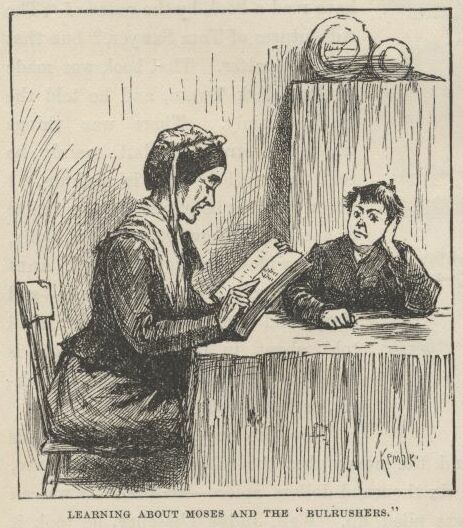
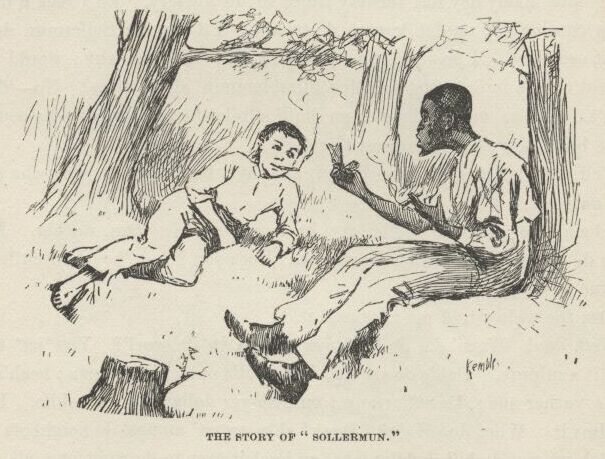
First is Huckleberry who has his own language to utter his thoughts or feelings. At first Huck speaks like a naïve village boy but then he improves his speaking as the result of his unconscious acceptance of Mrs Douglas and Mrs. Watson’s education. This state exists when Huck tell stories of Moses, King of Solomon and Louis XVI to Jim. But in a part of the story Tom Sawyer accused him as a dull boy though he has already have read Don Quixote.  His freedom addict makes him live uncomfortable with Mrs. Douglas. Sometime his thought or feeling is not uttered but only occurred inside of him, still, it has impact on his behaviour so that other people may notice what goes in his mind.
“I couldn’t stood it much longer. Then for an hour it was deadly dull, and I was fidgety. Miss Watson would say, ‘Don’t put your feet up there, Huckleberry; and ‘Don’t scrunch up like that, Huckleberry – set up straight’ and pretty soon she would say, ‘Don’t gap and stretch like that, Huckleberry – why don’t you try to behave?” [2]
Jim is a big black slave of Mrs. Watson. He soon becomes Huck friend or side-kick through their journey to Cairo, Illinois. As an uneducated watchman, Jim also has his own language which influenced by his background or culture in believing thing, for example when he was asked by Huck about Father Finn, he asked to his hairy ball. When he speaks, his words are structurally wrong but Huck and other persons can understand his intention. But Jim gets a hard time to comprehend Huck’s explanation about French and English people using the example of a cat and a cow.
“Well then, why ain’t it natural and right for a French-man to talk different from us? You answer me that.”
“Is a cat a man, Huck?”
“No.”
“Well, den she ain’t got no business to talk like either one er the yuther of ‘em. Is a Frenchman a man?”
“Yes”
“Well, den! Dad blame it, why doan’ he talk like a man? You answer me dat!” [3]

Colonel Grangerford is a gentleman and his aristocracy exposes on the way he talks and acts. Huck is amazed by his performance. His words are gentle but straight to the point. I presume anyone talking to him will feel his self pride and awareness but it seems that everyone loves him.

            “There – I reckon it’s all right. Come in” [4]

Buck is Huck’s slave given by Col. Grangerford. His words are uttered perfectly in good sequences. He is the contrary of Jim. Perhaps it caused by his improvement and education in Col. Grangerford household. Huck feels the same way like I do, so in a part of the story Huck asked him to investigate whether his feeling is true or not.
            “Can you spell, Buck?”
“Yes,” he says.
“I bet you can’t spell my name,” says I.
“I bet you what you dare I can,” says he.
“Allright,” says I, “go ahead.”
“G-o-r-g-e J-a-x-o-n – there now, he says.
“Well,” says I. “you done it, but I didn’t think you could. It ain’t no slouch of a name to spell – right off without studying.”[5]

Lie is also an outcome of someone’s thought and expressed on his action or words.  Huck tells many lies some are useful and some don’t. Finn thinks that making lie is tolerable to have fun or to save his or others life. His first lie is when he was still living with the widow. His biggest lie is the making of his own death which leading Pap Finn and Jim, the slave, accused as the murders.


Reference
Bracher, Mark, “Jacques Lacan, Diskursus dan Perubahan Sosial: Pengantar Kritik-Budaya Psikoanalisis”. Jalasutra. 1997.
Leahy, Louis. “Human Being”. Kanisius. 2008.


[1] Leahy, Louis. Human Being. Kanisius. 2008. Page 39
[2] Twain Mark. Tom Sawyer and Huckleberry Finn. London. 1991. Page  238-239

[3] Twain Mark. Tom Sawyer and Huckleberry Finn. London. 1991. Page  324
[4] Twain Mark. Tom Sawyer and Huckleberry Finn. London. 1991. Page 343
[5] Twain Mark. Tom Sawyer and Huckleberry Finn. London. 1991. Page 346

Rabu, 15 April 2009

The Heart of A Poetry


In preface to the second edition of Lyrical Ballads, William Wordsworth alters relationship between poem and reader to poet and poem. It doesn’t mean that he didn’t consider the reader. He considers the poet as a teacher of natural intuitions and describes the idea of poet by stating: “a man speaking to men; a man, it is true, endowed with more lively sensibility, more enthusiasm, and tenderness, who has a greater knowledge of human nature, and a more comprehensive soul, than are supposed to be common among mankind.” While he describes the idea of poem as “spontaneous overflow of powerful feelings; it takes its origin from emotion recollected in tranquillity.” Wordsworth’s preface offers the theory of poetic diction by attacking the popular style using a gaudy and inane phraseology veiling nature rather than revealing its spirit. Readers who have been accustomed to the gaudiness and inane phraseology of many modern writers will struggle with the feelings of strangeness and awkwardness. Wordsworth doesn’t want to be censure for his propose and explain for the main reasons of determining his propose.

Wordsworth was advised once to prefix a systematic defence of the theory upon which the poems were written, but he was unwilling to do it since he might be suspected of having been influenced by the selfish and foolish hope as well adequately displayed the enforcing arguments. Without saying any few words it is easy to notice that poem has different materials than others and by writing in verse an author makes a formal engagement gratifying habits of association. It also reflects the different expectations from every different literature eras. So that propose of the poem is to choose incidents and situations from common life, to relate or describe them which at the same time let imagination go wilder. This could make ordinary things presented in an unusual aspect. All good poetry is the spontaneous overflow of powerful feelings. Thus, each poem has a purpose and his purpose is to imitate and to adopt the language of men which prompted by passion. A poet is a man speaking to men, he is a man pleased with his own passion and volitions as well rejoiced more than others in the spirit of life. He has an ability to conjure up in himself passions which are far from being the same as those produced by real events. Further he has acquired a greater readiness and power in expressing what he thinks and feels especially thoughts or feelings from his own mind. Wordsworth believes that poetry is the first and last of all knowledge, as immortal as the heart of man. In conclusion, he wants reader will determine how far a poem has been attained and what will be worth to be attained; for that he lets the claim to the approbation of the public

Senin, 09 Februari 2009

Rasisme dan Perbudakan sebagai Isu Moral pada Pidato Abraham Lincoln


Moral dan etika muncul dalam aspek kehidupan sehari-hari seseorang, tidak masalah apa status dan gendernya kedua hal tersebut seolah mengikatnya, sehingga apabila melewati batas yang dibuat oleh etika maka dia dianggap tidak bermoral. Moral selalu dilihat berdasarkan pelaku dan perbuatannya, apapun penyebab dibaliknya tidak terlalu dihiraukan. Pengajaran moral selalu ada dalam setiap kebudayaan dan belumlah beradab jika tidak berperilaku sesuai etika atau moral yang telah ditentukan oleh masyarakat. Maka oleh karenanya adalah lebih baik kita mengetahui apa yang dimaksud dengan moral dan etika tersebut. Moral adalah suatu keyakinan atas apa yang salah dan benar, sementara etika merupakan sebuah prinsip yang berasal dari kata ethos yaitu karakter atau kebiasaan.

Rasisme adalah permasalahan moral yang paling controversial di Amerika sejak dulu. Perbudakan merupakan satu hal yang tidak bisa diabaikan menjadi factor pendorong kkemajuan Amerika untuk menjadi satu Negara besar. Karena perbukan pula, bangsa Amerika dapat menyadari adanya permasalahan moral yang luar biasa. Masalah ini diungkit oleh  Presiden Abraham Lincoln setelah terjadinya perang saudara.
Pada kenyataannya Lincoln tewas dibunuh oleh seorang kulit putih ketika masih menjabat sebagai seorang presiden Amerika Serikat ke-16, saat ini pun masalah rasisme masih terjadi di berbagai belahan Negara Amerika Serikat meskipun tidak seburuk yang terjadi pada masa-masa Lincoln dan setelahnya. Penulis merasa tertarik untuk melihat pidato pengangkatan Lincoln sebagai sebuah “lip service” terhadap pemilihnya ataukah benar adanya berasal dari hati nuraninya yang tidak menghendaki perbudakan demi kesetaraan derajat.

Manusia (man) dibekali akal (mind) sehingga dia dapat belajar banyak hal dari lingkungan sekitarnya dan menjadikannya menguntungkan bagi dirinya. Namun, lingkungan tempatnya tinggal memiliki aturan yaitu moral dan etika sehingga perilakunya dikontrol oleh kedua hal tersebut. 
Morality is a kind of policy or instrument: the moral agent is a centre of practical reason for whom morality is a means to a further end and whom altruism stands in need of an external (empirically describable) pay-off. [1]
The moral attitudes of blame and disapproval are neither merely feelings nor utilitarian strategies, but are deeply and essentially involved in the way we conceive of human action.[2]
…the image in contemplation is neither pleasurable nor painful; and it does not attract to itself either moral approval or disapproval.[3]

Perang saudara yang digenjarkan sebelum Lincoln diangkat menjadi presiden dan memberikan pidato pertamanya membuat penulis menjadi ingin tahu apakah peperangan tersebut memang terjadi karena adanya kesadaran untuk mengakhiri perbudakan atau hal-hal politis antara Partai Republik dan Demokrat.
Apprehension seems to exist among people of the Southern states that by the accession of a Republican administration their property and their peace and personal security are to be endangered.[4]
Diketahui sebelumnya bahwa dari Partai Republik-lah karir politik Lincoln mulai menanjak ketika menyampaikan pidato di Peoria dan mengangkat masalah perbudakan. Setidaknya dari yang penulis ketahui, Lincoln berhasil menjadi tokoh nasional dari partainya meskipun dia mengalami kekalahan ketika harus berhadapan dengan Stephen Douglas dari partai Demokrat.
Political theory is a dangerous sort of thinking: it is neither a science which tries to understand, predict and control the workings of nature, nor a pure philosophy which tries to define the character of thinking and of reality itself.[5]
Melihat dari sisi politik selalu memiliki dua sisi, dimana masing-masing sisi seolah berjuang untuk orang lain. Hal ini memunculkan perselisihan yang berujung pada peperangan dan kematian karena semuanya merasa paling benar. Mengatas namakan liberalism, nasionalisme, demokrasi, sosialis ataupun komunis membuat peperangan semakin buruk. Politik tidak hanya mempengaruhi bentuk pemerintahan saja tetapi juga kehidupan pribadi seseorang, dan hal ini bisa menjadi pemicu perang saudara.
Rasa kecintaan terhadap sesama dan bangsa membuat seseorang rela berkorban harta, waktu dan jiwanya. Lincoln pun mengalami hal yang sama pada saat menyampaikan pidatonya. Adanya perasaan senasib sepenanggungan membuat Lincoln maju untuk membela kaumnya dengan menghapuskan perbudakan di Amerika Serikat tetapi penulis melihatnya memiliki dualism pemikiran.
“I have no purpose, directly or indirectly, to interfere with the institution of slavery in the states where it exists….”[6]
Disebabkan oleh dualisme inilah penulis menganggap Lincoln memiliki tujuan atau dorongan yang samar, apakah dia murni terdorong oleh moralitasnya ataukah sebagai negarawan yang akan memperoleh dukungan jika mengangkat isu moral.
Dualisme ini pun tidak menguntungkan Lincoln dari segi ekonomi. Negara-negara bagian Selatan dan Utara memiliki pergerakan ekonomi yang berbeda, dimana Negara-negara bagian Selatan memproduksi tembakau, beras dan gula dengan harga murah, begitu juga pada produksi kapas. Sementara di bagian Utara, meskipun mereka merendahkan sistem perbudakan, mereka tetap ingin harga-harga produksi tetap rendah. Hal ini yang lalu menimnulkan kegoncangan ekonomi dengan adanya kampanye dan kritik untuk mengakhiri perbudakan. Lincoln menyadari ini dan menyinggungnya dalam pidatonya si dewan senat sebagai wakil dari partai Republik di Illinois.
This government cannot endure permanently half slave and half free.”[7]
Dengan menyampaikan pernyataan semacam ini, Lincoln ingin menunjukkan niat baiknya kepada seluruh konstituennya. Pidato di depan Senat ini sepertinya merupakan titik awal bagi Lincoln mengangkat isu rasisme dan moral. Lincoln berpikir bahwa satu bangsa tidak akan maju apabila warga negaranya hana sebagian saja yang merasakan kebebasan. Penulis merasa langkah ini tetap politis karena politisi-politisi lain menginginkan keseimbangan jumlah antara yang merdeka dan yang budak. Meskipun demikian, Lincoln membuat peperangan tidak lagi terhindarkan.  Bagaimanapun, Lincoln tetaplah seorang tokoh besar yang memimpin dengan penuh moral dan etika berdasarkan rasa cinta dan keadilan yang dimilikinya. Lincoln bukan mengharapkan musnahnya perbudakan tetapi berharap memiliki satu Negara utuh yang bersatu.
Tugas utama Lincoln adalah menjalankan dan menjaga kestabilan persatuan antara Utara dan Selatan khususnya. Berdasarkan sejarah pun, pada kenyataannya, Lincoln lebih peduli pada nasib warga kulit hitam dan caranya untuk mengatasi hal tersebut adalah dengan membuat Proklamasi Emansipasi. Dia membagi dua kubu untuk mengawasi pelaksanaan kosnstitusional tersebut, mayoritas dan minoritas.
…and we divide them into majorities and minorities. If minority will not acquiesce, the majority must, or the government acquiescence on one side or the other. [8]
Penulis menganggap dengan adanya pembagian ini, setidaknya Lincoln menginginkan kesetaraan posisi dan ras antara hitam dan putih menjadi mungkin, sebab dia memberikan kulit hitam untuk membuat sebuah persetujuan. Atau mungkin jika tidak membuat sejajar Lincoln berusaha menengahinya.

Alasan-alasan yang digunakan seseorang untuk memperjuangkan hak-hak hidup orang lain tentunya didorong oleh kejujuran dan kasih sayang yang lalu  tercipta dalam sebuah moralitas. Manusia tercipta dengan segala kekayaan dan kerumitannya, Tuhan memberikannya satu bagian yang membedakannya dengan makhlukNya yang lain. Satu bekal yang tidak hanya digunakan untuk mengetahui sesuatu saja tetapi juga untuk memperbaiki kualitas akal. Yaitu akal yang kemudian menjadi hasil pikir, moral.
Etika dan moral adalah buah kebaikan dari sebuah nilai. Nilai kehidupan yang didalamnya terdapat kehidupan, cinta, kebenaran, keadilan, kebebasan, kreatifitas dan lainnya. Ras tidak mampu menunjukkan siapa yang lebih baik, unggul ataupun paling bijak. Semuanya hanyalah ego manusia untuk merasakan lebih dari segalanya.
Moral dan etika dibuat untuk membentengi hal-hal yang kelak akan merugikan orang lain di masa depan. Kedua hal tersebut ada tidak tanpa kesalahan, karena keduanya adalah hasil pemikiran manusia yang berusaha menjadi lebih baik. Kecerobohan, kebodohan, ketumpulan akal manusia tidak menghalanginya untuk selalu berbuat lebih, kesalahan yang pernah dilakukannya akan membuat seseorang tersebut memiliki nilai, moral dan etika tersendiri.

Daftar Pustaka
Crossman, R. H. S. Government and the Governed. London. 1958
Palmer, Frank. Literature and Moral Understanding: A Philosophical Essay on Ethics, Aesthetic, Education and Culture. Oxford. 1992
Plamenatz, James. Man and Society. New York. 1992


[1] Palmer, Frank. Literature and Moral Understanding. 1992.hal.60
[2] Ibid. hal 79
[3] Oakeshott, Michael. The Voice of Poetry in the Conversation of Mankind.
[4] Abraham Lincoln First Inaugural Addresses
[5] Crossman, R. H. S. Government and the Governed. London. 1958.Hal 1.

[6] Abraham Lincoln First Inaugural Addresses
[7] Ibid
[8] Ibid